 “hack” + “marathon”,
 hacking refers to inventive problem-solving in this context. A hackathon is an event where people come together with diverse ideas and skillsets to rapidly design and build products (usually software) over a relatively short period of time such as 24 or 48 hours.
Now, I’m moving beyond hackathons with a focus to launch products into actual users’ hands.
Hackathon Navigation
- How to Win - Content Links : for a table of contents of all my writings from hackathons
- Shoutouts : my heartfelt appreciation for the people that made the journey special
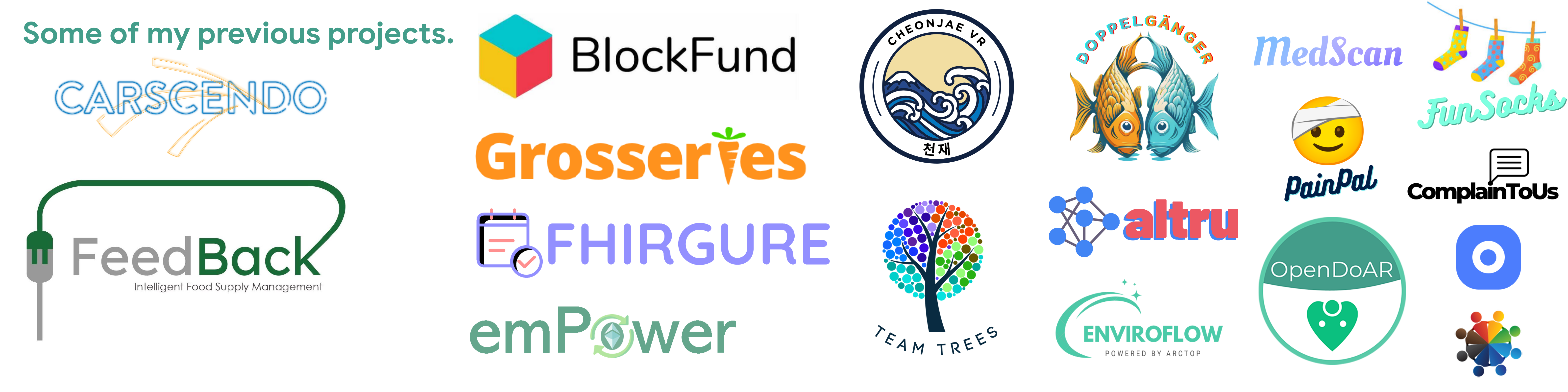
- Projects : a showcase of my hackathon projects seed
Why do so many?
It’s simply fun.
I got to build cool stuff, with interesting people. And it became an iterative feedback loop of growth. I got to make mistakes in a low-risk environment and learn from it.
Perks,
- Structured, focused and time-capped exposure to new technologies, problems and ideas
- Intense challenge and constant mental exercise to think different
- Worked with over 130 different people
- Opportunity to lead over 30 teams
- Technical and non-technical up-skilling
- Exposure and implementation of the cutting-edge of technology and innovation
- Great people and relationships: hacked with, mentored by, connected with, inspired by, learnt to work with…etc
- Make friends across the world
- Got flown to the US and S.Korea
- Learnt to deliver with limited resources and win
Costs and Warnings,
- Can take a lot out of you
- Time + energy costs
- Opportunity cost
- Can result in purely short-term outcomes
- Doing too many, especially when successfully, can lead to more rigid practices that aren’t the best if not careful
- Trade-offs between winning and learning priorities
- Diminishing returns
My Statistics
- 24/34 wins overall, ~70% win rate
- 17 wins with strangers
- 3/4 solo wins
- 6/8 wins with fully randomised teams of strangers
- 11/17 wins for US hackathons (usually attracts a higher-level of participants and prizes)
- Hacked with 132 different people – >85% strangers
- Post-hack feedback: >90% would want to work with me again
- On separate occasions, hacked twice with 3 people
- On separate occasions, hacked thrice with 1 person
- 25k+ words of feedback, reflections, learnings and stories.

. - Big wins at Stanford x2, Yale, MIT, and Seoul National Uni. & Meta
- Flown to US x2 and S.Korea x2
. - Longest Hackathon done: 3 months, 3 rounds - won 1st overall and in APAC
- Shortest Time starting to hack: 4 hours before deadline/36hrs, HackMIT, won 3rd in sponsor track
- Largest Team worked with: 15 fully randomised strangers - won 1st overall and nationally
- Median Team size of 4
- Number of times I’ve posted that I won a hackathon: 0 😛
- Number of hackathon-related/tech/startup T-shirts: > 30
To clarify, while winning is cool and I’m flexing here as a signal.
I learnt a lot from losing, and often those lessons are more significant.
Fundamentally, the real ‘wins’ are from the learnings – because those scale and pay-off perpetually.
Wins
Won in 24/34 hackathons✨
Actually, I’ve done about 41 hackathons 🏞️ I decided to not count my most recent ones towards my win-rate calculation to free myself from caring about win-rate when I had different objectives than winning or it had no winners.
I write about How to Win - Table of Contents from a non-technical and technical perspective. A thorough collection of principles, systems, and concepts that are transferable to other ambiguous situations and delivery-intensive contexts like in startups or in working with others.
| Hackathon Wins |
|---|
| Upstage AI Hackathon | Top 7 finalist, flown to S.Korea |
| SXSW Autonomous AI Agent Hackathon | 1st Place Winner – complaints triage |
| Metaverse Policy Hackathon (Meta & Seoul Natl. Uni.) | 1st Place Win/150+ APAC teams. Finals in Seoul. |
| MiamiHackWeek | 1st Place Best AI app, & Best Use of OpenAI – generating presence for famous figures |
| MIT Generative AI Hackathon | 2nd Place – personalised illustrations in novels |
| MIT RealityHack | ArcTop Prize(solo 1st), & giving patients a brush to illustrate their pain |
| Commbank Case Competition | 2nd Place – streamlined and personalised feedback |
| MIT RealityHack | Travel Scholarship Prize – gamifying and visualising hacker teams’ progress |
| HackIllinois | 1st Place Winner Shark Tank – solo hacker: built MVP and pitched to VC judges |
| New York’s HackNYU | Dream Big Prize – ensures safer medication consumption |
| Stanford University’s TreeHacks | Accessibility Grand Prize – music composition accessibility via VR |
| Yale CBIT Healthcare Hackathon | 2nd Place Winner – giving people control of their health data |
| LongMileHack | 1st Place Winner & People’s Choice Award – DAO shared renewable energy projects |
| MIT’s HackMIT | 3rd Place Best use of InterSystems FHIR services Challenge |
| UC San Diego’s SD Hacks | Best Sustainability, & Hardware Hack, 2 Sponsor Prizes |
| Stanford University’s TreeHacks | Most Impactful Hack Prize, Best use of Alchemy API |
| Unleash Hack Australia | 2nd Place Winner & People’s Choice Award |
| Microsoft APAC AI Accessibility Hackathon | Singapore Region Finalist (top 5/29) & Most Impactful Hacker Award (1/579 participants): competed as solo student against working professional teams |
| Enactus x Venture Hackathon | grant funding secured |
| UHack | 3rd Place Winner – remote work social interaction |
| National Innovation Games | 1st Place Winner – embedded information in captions |
| GovHack | National 2nd Place Winner & State Award People’s Choice – skill trees representation for learning |
| Joondalup Innovation Challenge | 1st Place Winner – empowering local business expansion |
| WorleyParsons Machine Learning Hackathon | 2nd Place Winner |
Other hackathons
- PetHacks
- Chevron Hackathon
- Humanitarian Innovation Challenge
- HackHarvard
- HackUTD
- TartanHacks
- CalHack
- iQuHack - MIT Quantum Computing Hackathon
- DevOps for GenAI Hackathon SF by MongoDB
- Multimodal Magic Interfaces Hackathon @ AGI House
- BlueSky AI Hackathon @Y Combinator San Francisco
- SPC + OpenAI Hackathon @South Park Commons
Freeing myself from caring about win-rate
Of 41 hackathons, 6 of those (the most recent ones, No. 35-40 in my 2024 US trip) were any of,
- Un-winnable/no prizes: “everyone’s a winner” 😆
- Purely for a learning objective: Like to try quantum computing or “to disregard product-sense and use as many gen AI APIs as I can to experiment for fun.”
- e.g. For the quantum hackathon, I had to leave halfway. I didn’t want concern about ‘win-rate’ to stop me from rocking up to learn.
- Beyond-hackathon objective: I’m here to get some structure and support to build a product I want to launch afterwards
Frankly, +1 win is quite a diminishing return at a certain point and I want to move beyond towards launching products into real users’ hands.
So before I flew to the US for Jan-Mar 2024, I wrote a quick note-to-self to frame my mindset and provide a constant reminder of why I was there.
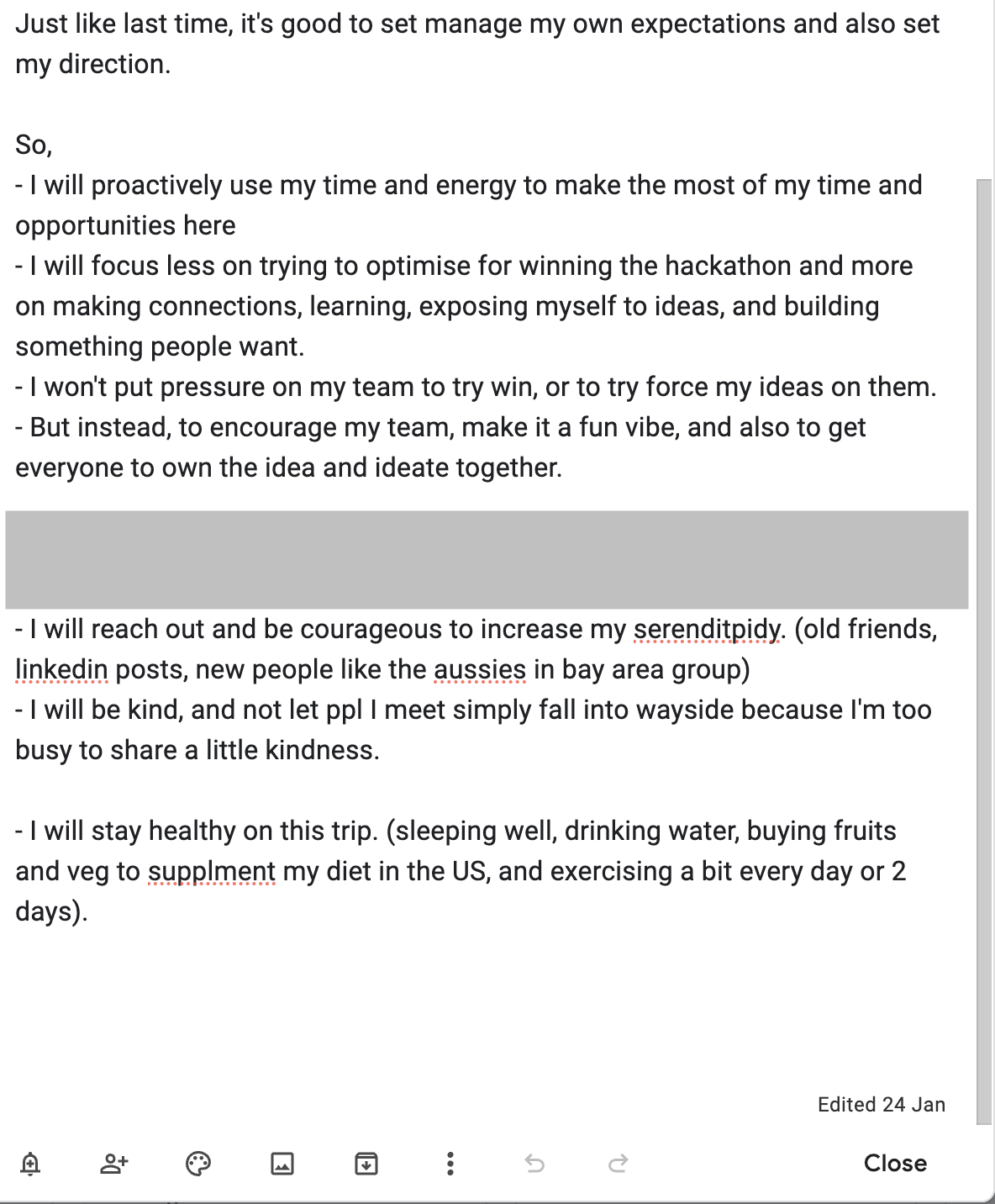
Approaching a hackathon to win vs to learn, is very different.
I decided to not count those non-winnable/purely learning/other objective hackathons in my win rate statistic.
Milestones
2018 Starting out: Runner-up for WorleyParsons Machine Learning Hackathon
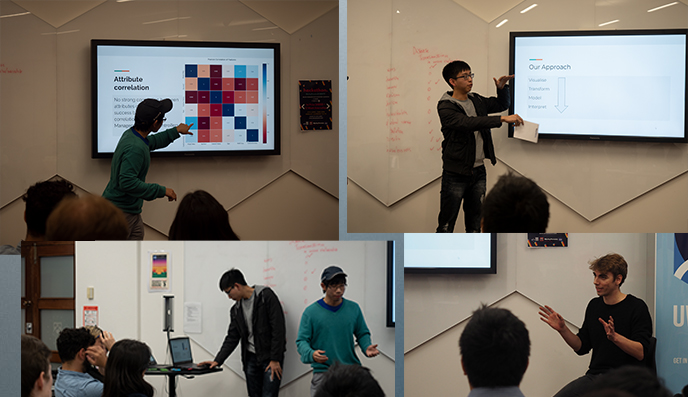
My first hackathon. Applied what I learnt from Stanford’s Coursera Machine Learning course.
Hackathons opened my world with cool problems outside my discipline and interesting people to work with.
I like using hackathons as a rapid feedback system. Each time with technical and non-technical learnings – and a few friends along the way.
The sponsors hired me afterwards :) and it was my first job.
2021 Levelling-up, challenging the big league US hackathons
Over two consecutive weekends in Feb 2021. I competed in TreeHacks (Stanford University’s intercollegiate annual hackathon), and SD Hacks (San Diego, Califonia’s largest hackathon).
I found success in Australian and Singaporean hackathons, but I often wondered how did I measure up in the US? When hackers do as many if not more hackathons as me, and everyone usually has a CS degree.
Joining teams of strangers once again for both, I was able to contribute both on a technical and collaborative level. Once could be a fluke, but twice told me I could really make a positive impact in a team to problem solve, ideate and develop solutions rapidly. More than just individual contribution, I could bring the team together and magnify their impact through project management, facilitation and encouraging their drive.
For TreeHacks, out of 224 submissions and with over 1000 of the best student hackers. Our team of 4 strangers won one of the 5 top prizes, and a sponsor prize:
Most Impactful Hack Prize: The project with the greatest potential social impact. Overall, our team won a drone each and some Ethereum to split.
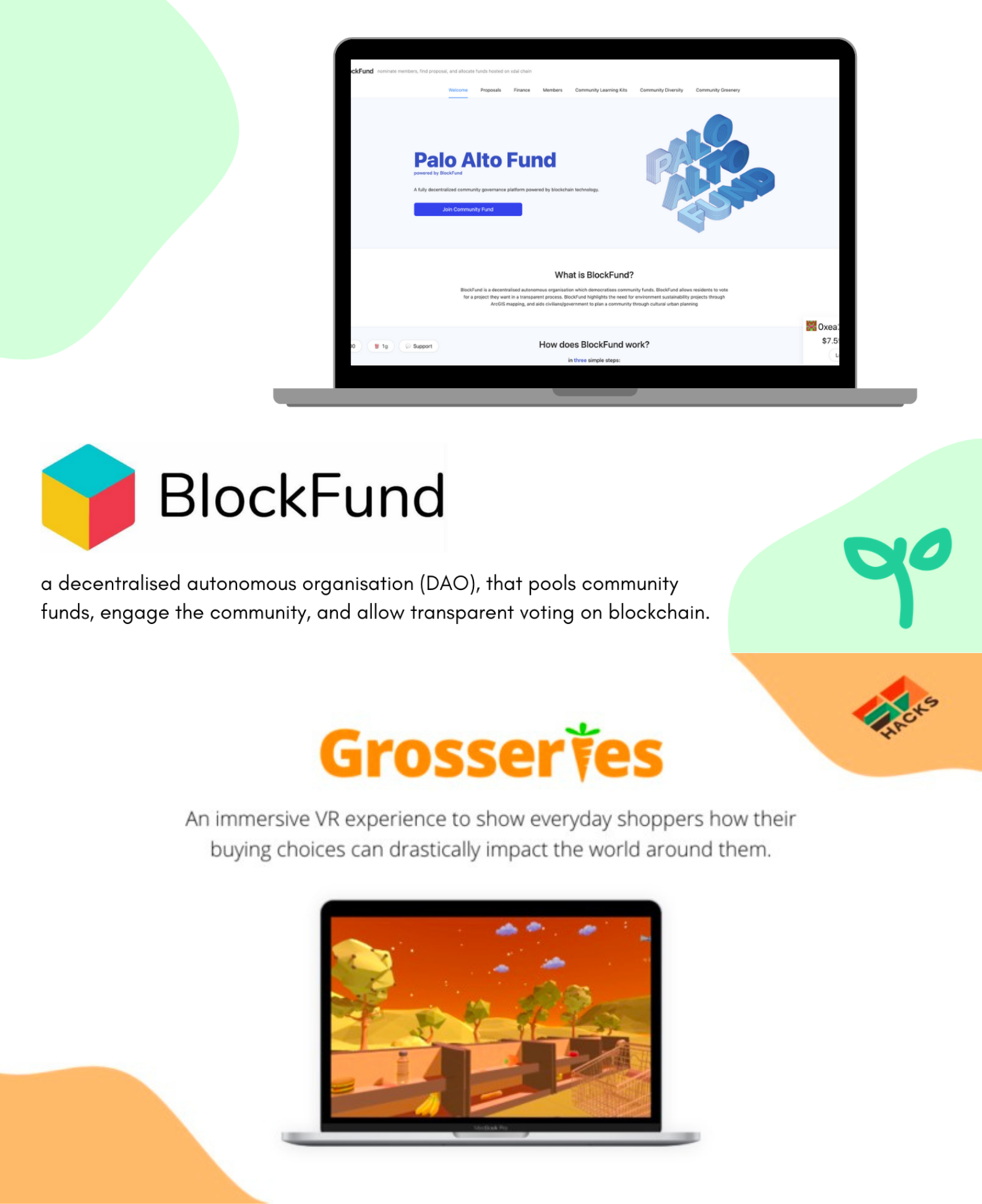
We built BlockFund - a blockchain-based webapp to help residents in communities vote in decisions to shape their surroundings and also inform their decisions.
For SD Hacks, out of 80+ submissions and with 500+ hackers. Our team of 4 (2 strangers, someone from my TreeHacks team, and me), won the grand prize for the “Sustainability” track. The next prize above is the “Best Overall Hack”. In addition, we won 3 sponsor prizes. Our solution was also the judges’ favourite, earning the most overall points from scoring.
We built Grosseries - an immersive VR experience to show everyday shoppers how their buying choices can drastically impact the world around them.
This was one of my favourite hackathons. I managed to convinced my team of web developers to take a risk and attempt this project despite all of us having no Unity/VR/Oculus experience previously. There were also two separate occasions where it was clutch (finding an adapter, finding a workaround)
2023 Diving into gen AI and my first-time in the US
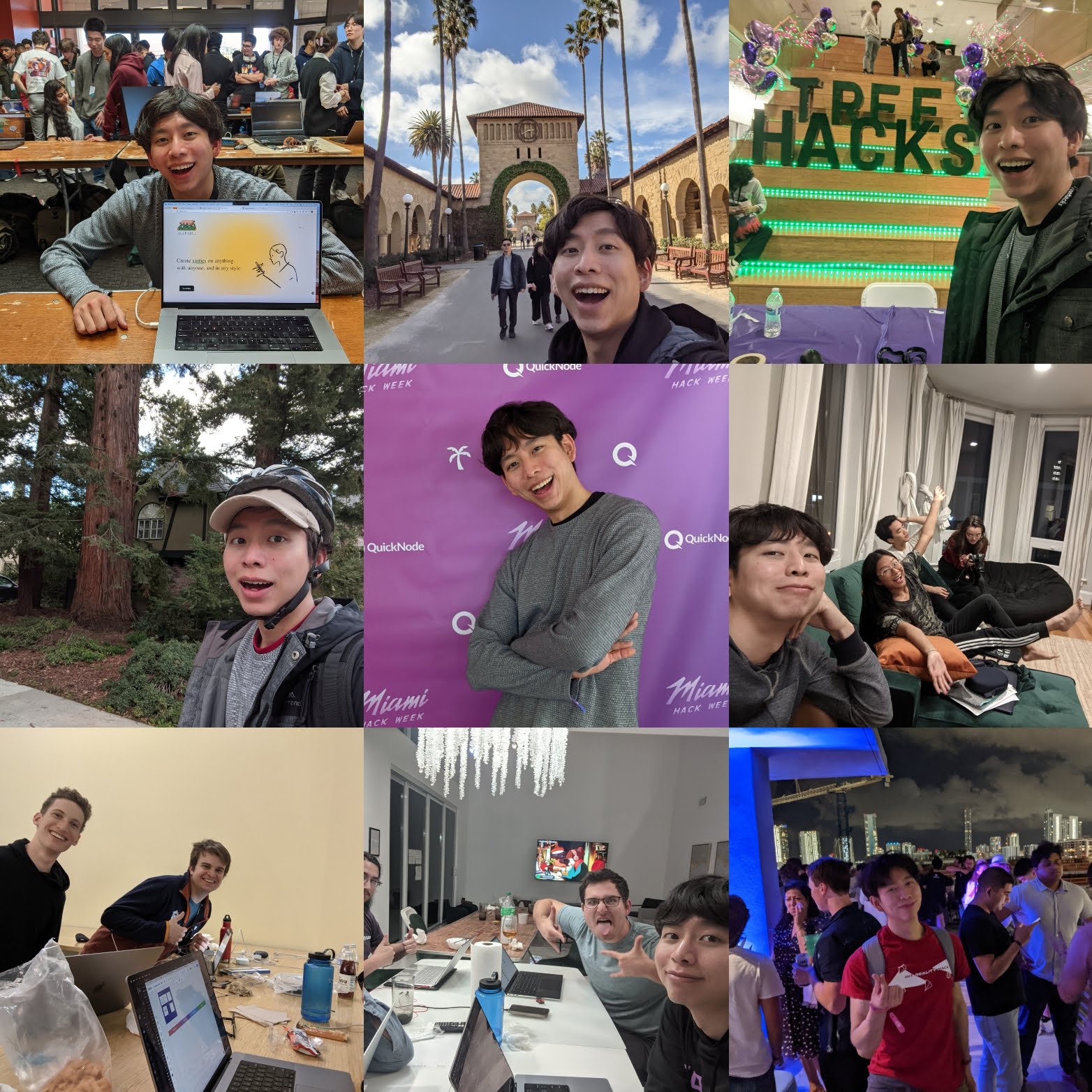
40 days of leave well spent : )
It started with getting invited to hack at the world’s largest AR/VR hackathon at MIT. After weighing the opportunity cost, I risked it for the biscuit and spent as much leave as I could to really immerse myself.
Across Jan/Feb of 2023, I travelled to Boston, Miami, and San Francisco’s Silicon Valley. I explored Stanford, MIT and Harvard – sneaking into my friends’ classes and rocking up to seminars (a highlight was speaking for 5 mins to Sal Khan). I won 3/4 hackathons – which winnings covered my entire trip expenses :) And I caught up with friends I only hacked with online before.
I'd like to thank Selena (one of the coolest and most inspiring I've hacked with) for hosting me in Boston and introducing the light of "everything but anchovies pizza" to me. It made my entire trip much more fun, and I felt a home away from home.
And my close friend, James, for encouraging me to go on the trip and for the therapy-on-demand when my video journalling wasn't enough.
Learnt a lot. I found journalling and hitting the gym even while travelling to be helpful in managing my own expectations and stress. It was also good exposure to the scene and opportunities in the US.