The largest economy of scale is a country, and the 'company' that services that – is its government. 🤔
I propose that countries – especially those with a military – should operate a department store of goods. I.e. Produce and sell clothing and certain basic goods for their citizens to access.
In doing so and in the right way, I think a lot of social good and value can be created.
These are my socks.
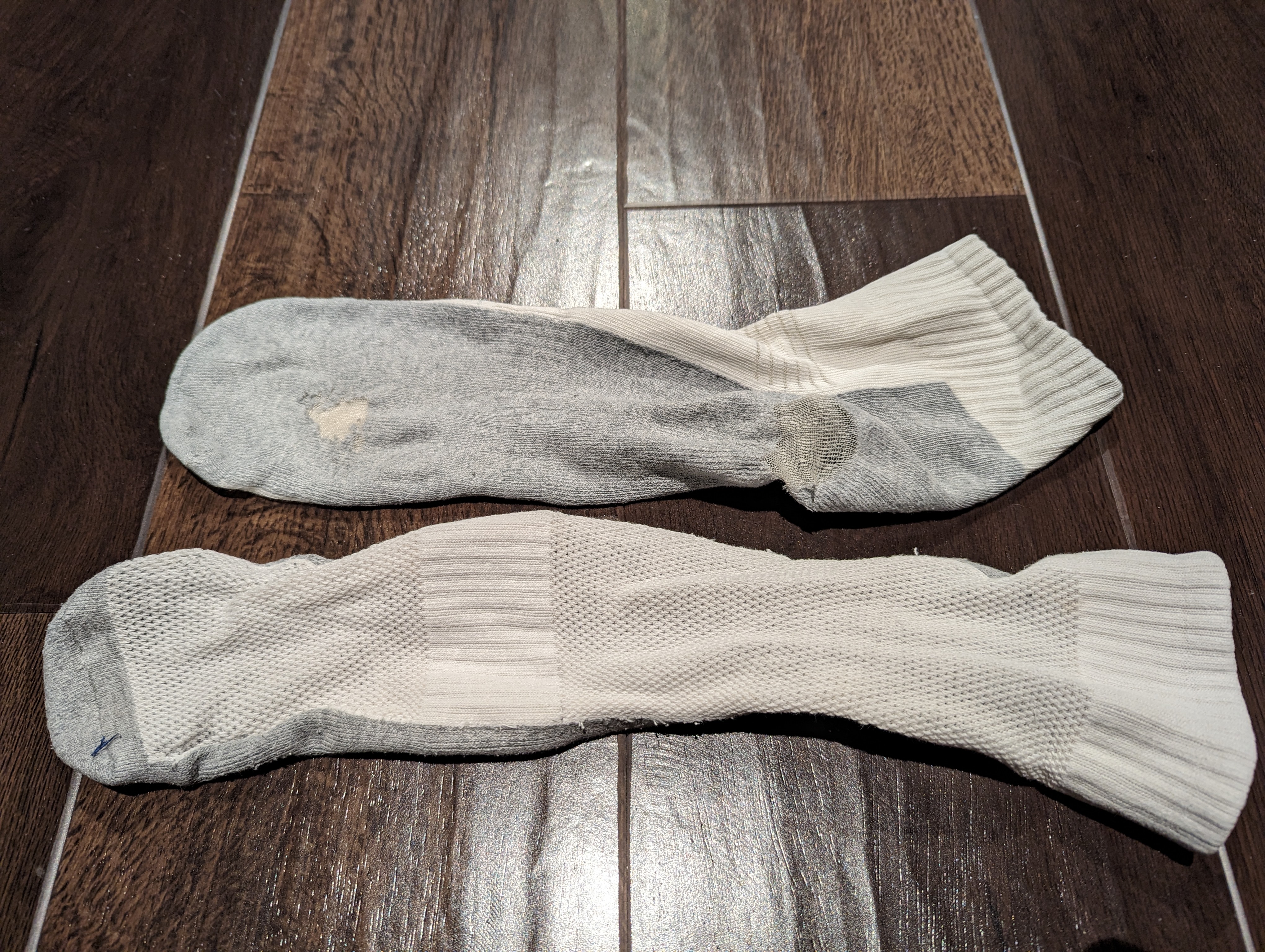
To the untrained eye and amateur – they might seem like:
- Socks
To the expert, they observe:
- Well-worn socks with stretching and fabric wear.
To any able-bodied Singaporean male over the age of 18, they are:
- Standard issue Singapore Armed Forces physical training socks
Correct, these aren’t just any socks.
They are one pair out of the dozen I own of army socks from my service time in Singapore’s military.
Why? Why Joey, are you still keeping and wearing them even 8 years after you left and countless use?
Simply because – they are the best. They are still functional! They are the best socks I currently own – in terms of quality, appropriate thickness for all conditions, moisture wicking, structure and comfort.
At the price point of free (ignoring 2 years+ of service), none of my other socks can compete with it.
I bought pricier socks at 3 a pair, still can’t beat. Even the thinest worn out section of my army socks beat the thickest section.
Why are these the best?
Consider this:
- Singapore has 2 years compulsory military service for all able-bodied males over 18.
- That’s ~50,000 full-time conscripts entering in and out.
- It’s a logistic feat to maintain, clothe, feed, arm, train and operate that force for the size of Singapore with limited land-mass and a population of around 6 million.
- Yet, it’s a logistical benefit in having a consistent customer base guaranteed for near perpetuity with the constant needs. The constant need here,
We need socks. A lot of socks.
That does not change. We will need socks, even if country XYZ invades or meteorite hits Z, we need need our feet wrapped in socks.
Military service is like your Netflix subscription
Military service is like your Netflix subscription - only that you have to subscribe and you have to watch what they assess is suitable for your skillset and personality.
Doing that over decades enables and results in stable operating conditions with more expenditure towards constant R&D that lead to downstream improved quality and value.
I cannot imagine a corporate entity achieving that level of economy of scale or operating stability to output a similar level of value at that price point. As a company’s objective is often to maximise shareholder value, either you increase prices or reduce costs (reducing quality). A great ratio is much harder to achieve due to multiple interests. Additionally, the margins would have to be wider.
However, a government’s objective in developing a military force – is different. There are multiple objectives too and it’s more complex in some aspects due to being less touched upon by everyday people. But a core objective is the soldier’s (or customer) experience – because a poorly equipped force is an unprepared and even worse, unhappy, force.
What’s the outcome?
I recently asked my cousin in Singapore to help me buy 20 pairs of standard issue army socks. They cost ~$1.17 USD each.
I imagine Singapore government recognises the potential and value to some extent – beyond just selling army surplus goods – and they operate an “E-mart”, a physical and digital storefront. At the E-mart, servicemen can spend their annually refreshing allocated credits to purchase items they need, and civilians can spend cash to get army-approved quality goods.
A country is the largest economy of scale
Kinda. Sure Apple, Google, McDonalds can operate at massive scale - surpass some small-medium countries.
But perhaps we’ll prefer Pear, ChatGPT, MOSBurger one day.
When we talk about consistent, stable and guaranteed demand – a country's population, its citizens are essentially super-loyal customers.
I’m generalising here, noting that in some countries – people want to get out/in and demographic changes in an aging population is notable.
Countries and governments are subscription services
However, I think it’s important to realise that citizens are essentially customers to a government. We cannot think of it the same way as that simple analogy – because a government has different objectives, abilities and limitations than a business entity. But it’s still helpful to consider.
e.g. citizens subscribe to a government’s policies and offerings in a country, in return for paying taxes (subscription fees)
Or citizens are employees
It could also be helpful to consider a country as a massive company and its populace are employees who work for it and gain benefits accordingly.
E.g. a citizen works in a certain department (their job and pays taxes) in a country (a massive company) and receives benefits in a great office (stability, roads, schools and hospitals) and policies (social mobility, pension, healthcare, education…etc)
Conclusion
I believe there is still significant untapped potential for governments to leverage their economy of scale to provide real-tangible value for its people that companies would likely never reach.
I hypothesise that a store point and GovTech are two avenues - both physical and digital where this can really service and provide value to a lot of people.
- Store point: Operate and sell military-grade clothing and basic necessities at high quality and low prices.
- Similar to Surplus Stores but rather than simply selling surplus (supply excess of demand), I’m proposing the exploration and establishment of demand. Imagine if your government’s military goods were marketed just as well, and at equal or higher quality to brands like The North Face, Under Armour or Lululemon.
- Financial value:
- Governments gain additional operating revenue.
- Or at least, minimise expenses in other areas. (a store is not just a selling point, it’s also a marketing channel and can perhaps give free socks or discounts for a customer who shows their fitness record…etc – improving citizen health and lowering healthcare costs elsewhere)
- Social value:
- People gain access to reliable, affordable and quality goods.
- Less people fall prey to consumerism tricks in business.
- Environmental value:
- Less wastage, longer product life.
- GovTech:
- Essentially, the digitalisation of government services.
- What happens when you get user-friendly and useful government software products for people to use.
- When the best Engineers want to work for government and digital products service a country’s population.
- Good examples: See Taiwan and Singapore.
- A bad example, a certain country’s government tax filling system is constantly lobbied against and its government cannot even pre-fill the tax return for its citizens – making it harder for them. Instead, the lobbying company commercialises that need and charges hundreds of dollars for it to everyday people.
Care and guardrails around implementation, corruption and distortion of intent is necessary
With great power comes great responsibility.
In finance, I’ve learnt that the free market is an effective way to price goods.
However, there are examples where markets can be manipulated.
Similarly, there are cases when democracy can be manipulated (e.g. fake news, voting sway…etc). Just like any form of governance – things can go wrong.
What happens if the State starts to outcompete the public/private businesses in producing many daily goods? Is that a good thing? Are the current public/private businesses appropriately servicing the public?
Lots of questions to answer.